
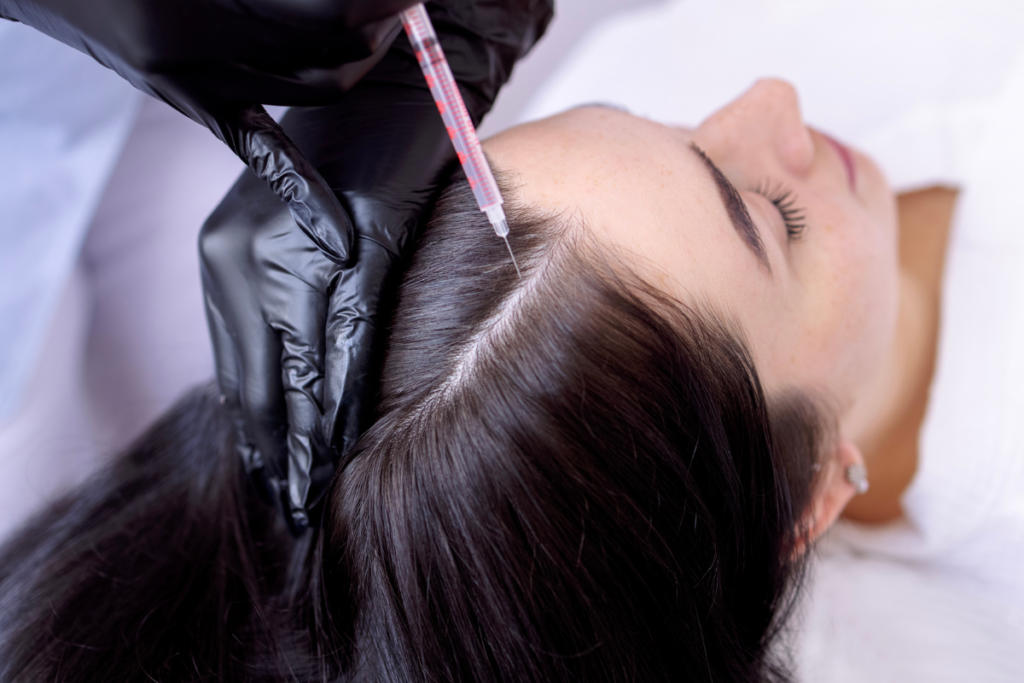
You notice your part looking wider, your ponytail feeling thinner, or more scalp becoming visible under bright light. You start searching for a hair loss treatment, and two names keep appearing: PRP and GFC. Both use components taken from your own blood, both are injected into the scalp, and both are discussed as regenerative options. So what really separates PRP vs GFC hair treatment?
The difference is mainly in how the blood sample is processed and what is finally injected. PRP contains platelet-rich plasma with concentrated platelets, while GFC is prepared to obtain a concentrate of platelet-derived growth factors. Neither treatment should be chosen simply because one sounds newer or more advanced. Your diagnosis, pattern of hair loss, follicle condition, medical history, and the evidence behind each option matter much more.
PRP vs GFC Hair Treatment: The Simple Difference
PRP uses plasma containing concentrated platelets, while GFC processing aims to release and collect growth factors from those platelets before the final preparation is injected into the scalp. Both are autologous, meaning they originate from your own blood, but the preparation methods and final biological products are different.
Platelets naturally contain signaling proteins involved in healing and tissue repair. With PRP, these platelets remain an important part of the injected preparation. GFC techniques focus more specifically on collecting platelet-derived growth factors after processing or activation.
This difference sounds straightforward, but there is an important detail: preparation protocols are not identical across clinics, studies, or commercial systems. Even PRP itself is not one completely standardized product. Research has used different platelet concentrations, centrifugation methods, activation techniques, injection depths, and treatment schedules.
What Is PRP for Hair Loss?
PRP, or platelet-rich plasma, is prepared by drawing a small amount of your blood and centrifuging it to obtain plasma with a higher concentration of platelets. The prepared plasma is then injected into selected thinning areas of the scalp with the aim of supporting follicles that are still capable of producing hair.
The American Academy of Dermatology includes platelet-rich plasma among procedures dermatologists may use for hair loss and emphasizes that effective treatment begins by identifying the cause of the hair loss first.
PRP has been studied most extensively in androgenetic alopecia, commonly called male or female pattern hair loss. This is a progressive condition in which genetically susceptible follicles gradually produce shorter and finer hairs. The U.S. National Library of Medicine explains that androgenetic alopecia affects both men and women, although the visible pattern usually differs between them.
What Does the Research Say About PRP?
PRP has a larger research base than GFC, but the evidence is not perfectly uniform. A 2024 systematic review of PRP for androgenetic alopecia evaluated clinical research investigating its effectiveness, while other reviews have reported improvements in hair density or thickness in selected patients.
One challenge is that PRP protocols differ considerably between studies. This means results from one preparation method cannot automatically be applied to every PRP treatment offered in practice.
You can also explore the clinic’s broader hair concerns section to understand how different patterns of hair loss may need different treatment strategies.
What Is GFC Hair Treatment?
GFC hair treatment uses growth factors obtained from a patient’s own platelets and prepared in a more concentrated growth-factor-focused formulation. The aim is to deliver biological signaling molecules to the scalp while reducing some of the cellular components present in conventional platelet-rich plasma preparations.
Growth factors associated with platelet preparations include signaling molecules involved in cell communication, blood-vessel activity, and tissue repair. In hair restoration, the proposed goal is to support suitable follicles and improve the environment around them rather than create completely new follicles where none remain.
Published research on GFC is growing but remains smaller than the literature available for PRP. A 2024 prospective GFC study, for example, involved only five patients with androgenetic alopecia. Its encouraging findings are useful for further research but are too small to establish that GFC is universally superior.
GFC vs PRP: Side-by-Side Comparison
| Feature | PRP | GFC |
|---|---|---|
| Source | Your own blood | Your own blood |
| Main preparation | Platelet-rich plasma containing concentrated platelets | Preparation focused on extracted or released platelet-derived growth factors |
| Research history | Larger clinical evidence base | Newer and comparatively smaller evidence base |
| Common area studied | Male and female pattern hair loss | Primarily pattern hair loss in current studies |
| Number of sessions | Usually performed as a treatment series; protocol varies | Usually performed as a treatment series; protocol varies |
| Downtime | Generally limited, with temporary scalp tenderness possible | Generally limited, with temporary injection-site discomfort possible |
| Can results be guaranteed? | No | No |
Does GFC Work Better Than PRP?
Current research does not justify saying that GFC is always better than PRP. Some comparative studies have reported stronger improvements or better patient comfort with GFC, while other research has found broadly comparable hair-regrowth outcomes. The evidence base for GFC is still developing, so treatment should be individualized.
A recent comparative study published in Dermatologic Surgery reported better outcomes for GFC in some measures, including total hair count and shaft diameter. These findings are encouraging, but a single study should not be treated as the final answer for every patient.
Another 2026 randomized controlled trial comparing GFC and PRP alongside topical minoxidil found comparable hair-regrowth and volume outcomes between the two groups, while GFC was associated with lower pain scores and better patient satisfaction.
Put simply, research is becoming more interesting, but there is not enough high-quality long-term evidence to declare one treatment the universal winner.
Which Hair Problems Can PRP or GFC Address?
These treatments are most relevant when viable hair follicles are still present, particularly in selected patients with pattern hair thinning. They are not a replacement for diagnosis and will not treat every cause of shedding, patchy alopecia, scarring hair loss, nutritional deficiency, thyroid disease, or other medical contributors in the same way.
| Hair Concern | What Should Happen First? |
|---|---|
| Gradually widening part or crown thinning | Assess for male or female pattern hair loss |
| Sudden heavy shedding | Look for triggers such as illness, stress, medication changes, or nutritional factors |
| Smooth circular bald patches | Rule out alopecia areata and other causes before regenerative treatment |
| Redness, pain, scaling, or scarring | Diagnose and control the underlying scalp disease first |
| Long-standing advanced bald areas | Assess whether enough functional follicles remain for non-surgical treatment |
This diagnostic step is why a comprehensive hair restoration treatment plan may involve more than injections alone.
What Happens During Treatment?
Both treatments begin with a blood draw. The blood is then processed using the protocol required for PRP or GFC. Once the preparation is ready, small quantities are injected across selected areas of the scalp.
You may experience temporary tenderness, pinpoint bleeding, redness, or mild swelling around injection sites. Comfort can vary between people and between preparation techniques.
Treatment is generally performed as a course rather than judged after one session. However, there is no single session schedule that applies to everyone. Published studies and clinical protocols use different intervals, which is another reason treatment plans should not be copied directly from advertisements or another person’s experience.
When Will You See Hair Regrowth?
Hair-regrowth treatment works slowly because the biological hair cycle takes months, not days. If treatment is helping, reduced shedding may become noticeable before visible improvements in density or thickness. Meaningful assessment usually requires standardized photographs, scalp examination, and adequate follow-up rather than checking the mirror after each session.
It is also important to define what “success” means. For some patients, maintaining current density and slowing further miniaturization can be clinically valuable. For others, increased thickness or improved visible coverage may be possible.
Common Mistakes When Choosing PRP or GFC
- Choosing by marketing language alone: “Advanced” or “next-generation” does not automatically mean more effective for your diagnosis.
- Skipping the diagnosis: PRP and GFC cannot correct every cause of hair fall.
- Expecting new follicles in completely bald areas: Regenerative treatments depend on suitable existing follicles.
- Stopping medical treatment without advice: Pattern hair loss often requires a broader long-term strategy.
- Expecting results after one session: Hair growth follows a slow biological cycle.
- Comparing yourself with online before-and-after photos: Hair-loss severity, lighting, styling, medications, and treatment protocols can all affect appearance.
PRP vs GFC or a Complete Hair Restoration Plan?
The most useful question is not simply “PRP or GFC?” but “What is causing my hair loss, and what combination of treatments fits that diagnosis?” Hair restoration may include medical treatment, correction of deficiencies when confirmed, PRP, GFC, other injectable therapies, or additional procedures depending on the individual.
At Ballani Skin Aesthetics, the hair loss and hair restoration approach begins with understanding the pattern and likely cause before deciding which procedure belongs in the treatment plan.
Frequently Asked Questions
What is the main difference between PRP and GFC hair treatment?
PRP contains plasma with concentrated platelets, while GFC processing focuses on obtaining growth factors released from platelets before the preparation is injected. Both originate from your own blood, but their preparation and final composition differ. The best option depends on your diagnosis, follicle condition, treatment goals, and dermatologist’s assessment.
Is GFC better than PRP for hair loss?
Not for every patient. Some recent studies have reported advantages for GFC in selected outcome measures or patient comfort, while other comparative research has found similar regrowth outcomes. PRP currently has a broader research base. More large, standardized, long-term trials are needed before GFC can be considered universally superior.
Can PRP or GFC regrow hair on a completely bald scalp?
These treatments are intended to support suitable existing follicles and are more relevant when follicles are still capable of producing hair. Long-standing smooth bald areas with significant follicle loss are less likely to respond like early thinning. A scalp examination helps determine whether regenerative treatment, medication, or another restoration option is appropriate.
How many PRP or GFC sessions will I need?
There is no universal number that suits every patient. Research protocols commonly use a series of sessions rather than a single treatment, but preparation methods and treatment intervals vary. Your dermatologist should decide the schedule according to the diagnosis, treatment selected, response, and whether other therapies are being used alongside it.
Can PRP and GFC replace hair-loss medication?
Not automatically. Pattern hair loss is a progressive condition, and injectable treatments may form only one part of a broader management plan. Depending on your diagnosis, a dermatologist may recommend topical or oral medication alongside regenerative procedures. Do not stop prescribed hair-loss treatment solely because you begin PRP or GFC.
Is PRP or GFC painful?
Both involve multiple scalp injections, so temporary discomfort is possible. Pain levels vary between patients and techniques. Some comparative research has reported lower pain scores with GFC, but this should not be the only reason to choose a treatment. Effectiveness, diagnosis, safety, and treatment goals should remain the main considerations.
If you would like to explore more patient experiences and treatment journeys, you can also read more inspiring stories.
Conclusion: Choose the Treatment Around Your Hair Loss
When comparing PRP vs GFC hair treatment, both approaches use components derived from your own blood, but they are prepared differently. PRP delivers platelet-rich plasma, while GFC focuses more specifically on concentrated platelet-derived growth factors. PRP has a longer and broader research history, while GFC is showing promising results in newer comparative studies.
The right hair regrowth treatment should not be chosen from a comparison chart alone. First identify the cause and stage of your hair loss, then decide whether PRP, GFC, medication, or a combined hair restoration treatment is appropriate for your scalp.
Ready to Understand Your Hair Loss Better?
Book a hair and scalp assessment: If you are deciding between PRP and GFC, schedule a consultation so your hair-loss pattern, scalp condition, and treatment suitability can be assessed before choosing a procedure.
Explore your treatment options: Learn more about our hair restoration treatments and discuss which combination may best support your long-term hair goals.