
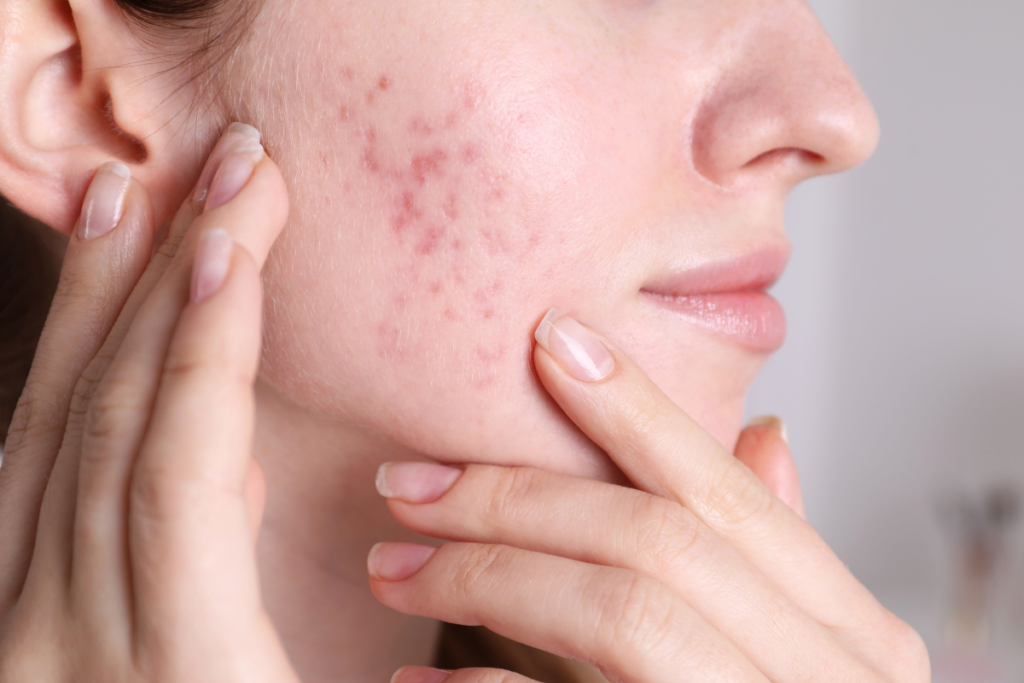
You may have already controlled your acne, yet the dents, uneven texture, and shadows left behind still catch your attention every time the light hits your face. When you start researching microneedling vs laser for acne scars, both treatments can sound convincing. One stimulates collagen with fine needles; the other uses controlled laser energy to remodel damaged skin. So which one should you choose?
There is no single winner for every acne scar. Microneedling, microneedling radiofrequency (MNRF), and fractional lasers such as fractional CO2 work differently, offer different recovery profiles, and may suit different scar patterns and skin types. The most effective acne scar treatment often begins by identifying the scars you actually have rather than choosing a device first.
Microneedling vs Laser for Acne Scars: The Simple Difference
Microneedling creates controlled microscopic punctures that stimulate collagen remodeling, while fractional laser creates microscopic zones of thermal injury using laser energy. Both can improve atrophic acne scars, but fractional CO2 laser generally produces a stronger resurfacing effect with more recovery, while microneedling usually involves less downtime and a lower risk of pigment changes.
The American Academy of Dermatology lists both microneedling and laser resurfacing among treatments dermatologists use for depressed acne scars. It also emphasizes an important point: ice-pick, rolling, and other scar patterns do not necessarily respond to the same procedure.
First, Understand What Type of Acne Scars You Have
Acne scars should be classified before treatment because different scar shapes respond differently to resurfacing, collagen stimulation, and scar-release techniques. A person with shallow boxcar scars may need a different strategy from someone with deep ice-pick scars or rolling scars tethered to deeper tissue.
| Scar Type | Typical Appearance | What Treatment May Need to Address |
|---|---|---|
| Rolling scars | Broad depressions that create a wavy surface | Underlying fibrous tethering may need release, sometimes combined with resurfacing |
| Boxcar scars | Round or oval depressions with clearer edges | Collagen remodeling and resurfacing may improve texture |
| Ice-pick scars | Deep, narrow pits extending into the skin | Often require targeted techniques rather than resurfacing alone |
| Post-acne pigmentation | Flat brown, red, or darker marks without a true depression | Pigment or redness treatment rather than scar remodeling alone |
| Raised scars | Firm scars sitting above the skin surface | A different treatment pathway from depressed acne scars |
DermNet similarly describes acne-scar treatment as a combination of resurfacing, lifting, subcision, excision, and other approaches depending on the scar.
How Does Microneedling Work for Acne Scars?
Microneedling uses fine sterile needles to create controlled micro-injuries in scarred skin, triggering a repair response that encourages new collagen and elastin formation. Over a series of treatments, this remodeling can soften depressed scars and make the overall skin surface look smoother and more even.
The American Academy of Dermatology’s microneedling guidance describes the procedure as minimally invasive and suitable for all skin tones when performed properly.
Where Microneedling Can Be Useful
- Mild to moderate atrophic acne scars
- Uneven skin texture
- Patients who prefer relatively limited downtime
- Skin types where post-inflammatory pigmentation is an important consideration
- Combination treatment plans involving other scar procedures
Standard microneedling does not use heat. This is one reason it can be an attractive option for people whose skin is prone to pigmentation after inflammation.
What Is MNRF for Acne Scars?
MNRF, or microneedling radiofrequency, combines needles with controlled radiofrequency energy delivered into the deeper skin. The needles create microscopic channels while radiofrequency produces controlled thermal stimulation within the dermis. This allows collagen remodeling at selected depths while limiting widespread injury to the skin surface.
MNRF should not be confused with ordinary microneedling. Both use needles, but the addition of radiofrequency changes the biological effect and treatment parameters.
A recent systematic review of fractional radiofrequency microneedling for acne scarring found that it is a promising treatment for atrophic scars while also noting the need for further randomized trials and standardized treatment settings.
How Does Fractional Laser for Acne Scars Work?
Fractional laser treats only microscopic columns of skin at each pass, leaving surrounding areas untreated to support healing. Fractional CO2 is an ablative laser, meaning it creates controlled columns of tissue vaporization and thermal injury that stimulate substantial collagen remodeling as the skin repairs itself.
DermNet’s fractional laser guidance lists acne scarring among established uses for fractional laser treatment and explains that fractional technology creates thousands of microscopic treatment zones rather than treating the entire skin surface uniformly.
Why Fractional CO2 Is Used for Acne Scars
Fractional CO2 can create substantial remodeling of scarred skin and is frequently considered for more established textural acne scarring. The trade-off is that stronger resurfacing generally means more redness, swelling, crusting, peeling, and recovery compared with standard microneedling.
Post-inflammatory hyperpigmentation is also an important consideration, particularly in darker or pigmentation-prone skin. Laser settings, skin preparation, scar type, and dermatologist experience therefore matter greatly.
Microneedling vs Fractional CO2 Laser: Side-by-Side
| Feature | Microneedling | MNRF | Fractional CO2 Laser |
|---|---|---|---|
| Energy used | No thermal energy | Radiofrequency energy | CO2 laser energy |
| Main action | Mechanical collagen induction | Needling plus deeper thermal remodeling | Ablative fractional resurfacing and collagen remodeling |
| Downtime | Usually lower | Usually moderate | Usually greater |
| Post-treatment redness | Generally shorter-lived | Variable | Usually more pronounced |
| Pigmentation concern | Relatively lower when performed correctly | Often suitable across skin tones with appropriate settings | Requires careful patient and parameter selection |
| Resurfacing strength | Gentler | Intermediate to strong depending on settings | Can provide more intensive resurfacing |
So, Is Fractional Laser Better Than Microneedling?
Fractional CO2 laser may produce greater improvement in some atrophic acne scars, but that does not make it the best choice for every patient. Microneedling and MNRF can offer meaningful improvement with different recovery and pigmentation profiles. Your skin tone, scar type, downtime tolerance, and previous treatments should influence the decision.
A systematic review comparing needling techniques with ablative fractional lasers found both approaches useful for scar treatment, reinforcing that the choice should be individualized.
More recent evidence comparing fractional CO2 directly with MNRF has added useful context. A 2026 meta-analysis of randomized trials reported stronger overall scar improvement with fractional CO2, while MNRF showed better tolerability. The authors also emphasized the importance of factors such as skin type, pain tolerance, and recovery expectations.
When Microneedling May Be the Better Choice
Microneedling may be considered when you have suitable atrophic scars, want collagen stimulation with less surface injury, have limited time for recovery, or have a skin type where pigmentation after inflammation needs particular attention.
It may also form part of a broader skin rejuvenation plan when texture and overall skin quality are being addressed alongside scars.
When Fractional Laser May Be the Better Choice
Fractional laser may be considered when stronger resurfacing is appropriate, the scar pattern is suitable, and you are comfortable with more visible recovery. Fractional CO2 can be particularly valuable when substantial textural remodeling is needed, provided the patient’s skin type and pigmentation risk are carefully considered.
That decision should be made after examining your scars in person rather than from photographs alone.
Sometimes the Best Treatment Is Not Either One Alone
Acne scar treatment is often more effective when different procedures are matched to different scar components rather than forcing one machine to treat everything. Rolling scars may need subcision, deep narrow scars may need a targeted technique, and broader textural irregularities may then be treated with microneedling, MNRF, fractional laser, or a combination.
The AAD notes that dermatologists frequently combine treatments for acne scars. This is particularly relevant when several scar types appear on the same face.
At Ballani Skin Aesthetics, the Acne & Scars approach can include microneedling and other supportive procedures according to the scar pattern and treatment plan rather than using a one-treatment-fits-all approach.
Common Mistakes When Choosing Acne Scar Treatment
- Choosing a treatment before identifying the scar type: Ice-pick and rolling scars may require different procedures.
- Treating scars while acne is still uncontrolled: New inflammatory acne can create new scars while you are treating old ones.
- Assuming stronger means better: More aggressive treatment also means greater inflammation and recovery.
- Ignoring pigmentation risk: Skin tone and previous post-inflammatory pigmentation should influence treatment settings.
- Expecting scars to disappear completely: Treatment aims to make scars less noticeable rather than promise perfectly scar-free skin.
- Judging results too quickly: Collagen remodeling continues after the visible redness has settled.
- Copying someone else’s treatment plan: Their scar depth, skin type, acne activity, and healing response may be very different from yours.
DIY Microneedling vs Professional Acne Scar Treatment
Professional microneedling and laser resurfacing should not be replaced with aggressive at-home needling. Home devices cannot reproduce medical treatment safely or predictably, and excessive pressure, poor hygiene, or repeated injury can cause infection, irritation, scarring, or unwanted pigment changes instead of improving acne scars.
The AAD specifically warns that at-home microneedling can irritate or damage skin and can potentially spread infections when the skin is punctured.
Frequently Asked Questions
Which is better, microneedling or laser for acne scars?
Neither treatment is universally better. Fractional CO2 laser may provide stronger resurfacing for selected atrophic scars, while microneedling generally offers less downtime and a favourable safety profile across skin tones. The best choice depends on scar type, depth, skin tone, pigmentation risk, recovery time, and whether other treatments are needed.
Is fractional CO2 laser better for deep acne scars?
Fractional CO2 can provide significant collagen remodeling, but deep scars do not all respond to resurfacing alone. Deep ice-pick scars may require targeted techniques, while tethered rolling scars may need subcision. A dermatologist should classify the scars first and decide whether CO2 laser should be used alone or after another procedure.
Is MNRF better than fractional CO2 for acne scars?
Recent comparative evidence suggests fractional CO2 may provide greater overall scar improvement in some patients, while MNRF can offer better tolerability and less post-treatment inflammation. MNRF can therefore be valuable when downtime or pigmentation risk is an important concern. Treatment settings and patient selection remain essential with either procedure.
How many microneedling or laser sessions are needed?
There is no fixed number for every patient. Session requirements depend on scar type, severity, treatment depth, device settings, healing response, and whether combination procedures are being used. Both microneedling and fractional treatments commonly require staged treatment, and improvement develops gradually as collagen remodeling continues.
Can microneedling or CO2 laser completely remove acne scars?
No procedure can guarantee complete removal of acne scars. The realistic goal is to soften scar edges, improve depressions and texture, and make scars less noticeable. Results vary according to scar depth and type. Combination treatment is often needed when a person has rolling, boxcar, and ice-pick scars together.
Can darker skin tones have fractional laser treatment?
Fractional lasers can be used in darker skin, but treatment parameters and patient selection require care because post-inflammatory hyperpigmentation can occur after laser-induced inflammation. Microneedling and radiofrequency microneedling may offer useful alternatives in pigmentation-prone skin. A dermatologist should assess skin tone, scar pattern, and previous pigmentation before treatment.
If you would like to explore more patient experiences and treatment journeys, you can also read more inspiring stories.
Conclusion: Match the Treatment to the Scar
When comparing microneedling vs laser for acne scars, the right answer depends on much more than which device sounds more powerful. Microneedling offers controlled collagen induction with relatively limited downtime. MNRF adds deeper radiofrequency remodeling, while fractional CO2 provides more intensive resurfacing but generally comes with greater recovery and pigmentation considerations.
The best results usually begin with scar mapping. Once your dermatologist understands whether you have rolling, boxcar, ice-pick, pigmented, or mixed scars, your acne scar treatment can be built around what each area actually needs.
Ready to Plan Your Acne Scar Treatment?
Book an acne scar assessment: If you are deciding between microneedling, MNRF, and fractional laser, schedule a consultation to have your scar type, skin tone, pigmentation risk, and treatment goals assessed properly.
Explore your treatment options: Learn more about our Acne & Scars treatments and laser and skin treatments to understand how different procedures may be combined for a personalized treatment plan.