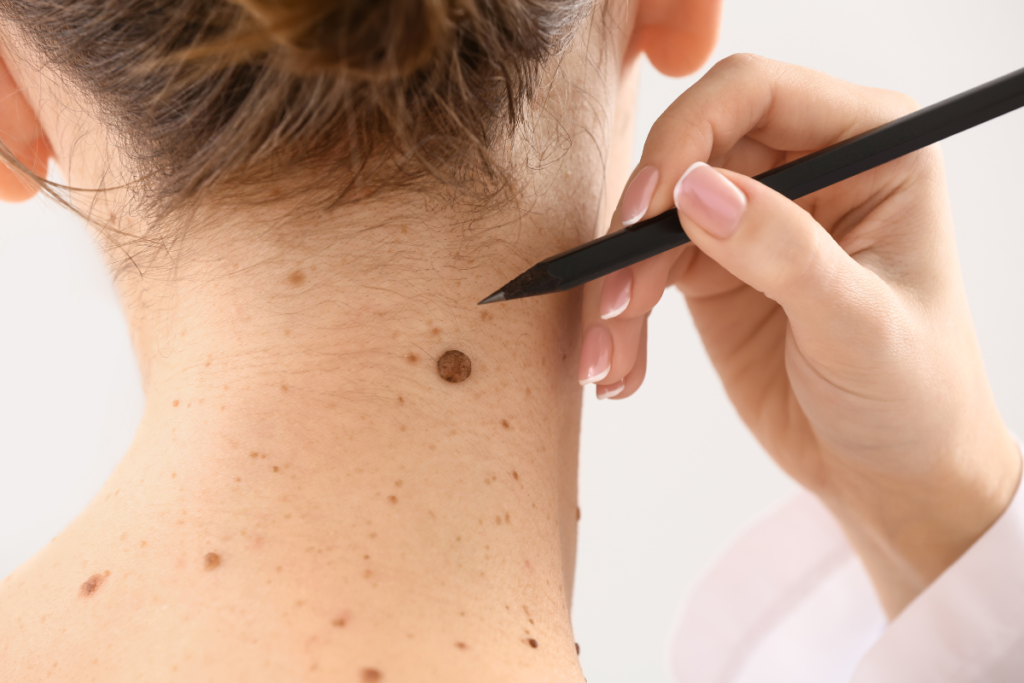
You notice a small raised growth on your neck, face, hand, or another part of your body. It may be smooth, rough, brown, flesh-coloured, or attached by a tiny stalk. The immediate question is often the same: is it a mole, a wart, or a skin tag? Understanding mole vs wart vs skin tag can help you recognize common differences, but appearance alone is not always enough for a reliable diagnosis.
Moles develop from pigment-producing cells, common warts are caused by human papillomavirus (HPV), and skin tags are soft benign growths that commonly appear where skin rubs against skin or clothing. Because some skin growths can resemble one another, anything new, changing, bleeding, painful, or unusual should be assessed before you attempt removal.
Mole vs Wart vs Skin Tag: What Is the Difference?
A mole is usually a pigmented growth formed by clusters of melanocytes, a wart is a viral growth caused by HPV, and a skin tag is a soft benign growth that often hangs from the skin on a small stalk. Their texture, colour, location, and development can provide clues, but a dermatologist should assess uncertain or changing lesions.
The NHS notes that skin tags can sometimes be confused with warts and moles. This is one reason it is safer to identify the growth properly before deciding whether it needs treatment.
| Feature | Mole | Wart | Skin Tag |
|---|---|---|---|
| Typical texture | Smooth or slightly raised | Often firm and rough | Usually soft and flexible |
| Typical colour | Skin-coloured, pink, tan, brown, or darker | Skin-coloured, greyish, brown, or darker depending on skin tone | Skin-coloured or slightly darker |
| Shape | Often round or oval | Raised or irregular, sometimes with a rough surface | Often hangs from a narrow stalk |
| Common locations | Can occur almost anywhere | Commonly hands, fingers, knees, feet, and other sites | Neck, underarms, groin, eyelids, and skin folds |
| Cause | Clusters of pigment-producing melanocytes | Human papillomavirus infection | Benign overgrowth of skin tissue |
| Contagious? | No | Yes, warts can spread | No |
What Does a Mole Usually Look Like?
Moles are common skin growths that can be flat or raised and may range from flesh-coloured or pink to different shades of brown. Many common moles are round or oval, have relatively regular borders, and remain fairly stable over time. Most ordinary moles are harmless, but changes deserve attention.
The American Academy of Dermatology explains that most adults have common moles and that these are generally harmless.
A mole may also contain hair or become slightly raised with time. Colour alone does not determine whether something is a mole, particularly because normal pigmentation varies considerably between different skin tones.
When Should a Mole Be Checked?
A useful screening guide is the ABCDE rule:
- A – Asymmetry: one half looks different from the other.
- B – Border: the edges become irregular, poorly defined, or scalloped.
- C – Colour: several colours or uneven colour appear within the same lesion.
- D – Diameter: larger size can deserve attention, although concerning lesions can also be small.
- E – Evolving: the mole changes in size, shape, colour, surface, or symptoms.
The AAD’s ABCDE melanoma guidance emphasizes evolution or change as an important warning sign. A spot that looks noticeably different from your other moles also deserves assessment.
What Does a Wart Usually Look Like?
A common wart is a benign viral skin growth caused by infection with certain types of human papillomavirus. Warts often feel firmer and rougher than skin tags and may have an irregular or grainy surface. They can appear individually or in groups and can spread to nearby skin or other people.
DermNet describes viral warts as common benign lesions caused by HPV infection.
Warts frequently appear on the hands and fingers, although they can develop in many locations. Plantar warts occur on the soles of the feet, while flat and filiform warts have different appearances and commonly occur in other areas.
Why Can Warts Spread?
Because warts are viral, HPV can spread through direct contact or through small breaks in the skin. Picking, scratching, shaving over, or repeatedly traumatizing a wart may also encourage spread to nearby areas.
This makes skin tag vs wart an important distinction. Skin tags themselves are not viral and do not spread from one person to another.
What Does a Skin Tag Usually Look Like?
A skin tag is generally a small, soft, harmless growth that may hang from the skin by a narrow stalk. Skin tags commonly appear around the neck, underarms, groin, eyelids, and other areas where skin folds or repeated friction occur. They may be skin-coloured or slightly darker.
The American Academy of Dermatology describes skin tags as harmless growths and notes that dermatologists can remove them safely when treatment is appropriate.
Why Are Skin Tags on the Neck So Common?
Skin tags on the neck commonly develop in an area exposed to repeated friction from skin, collars, necklaces, or clothing. They may also occur in groups. While they are usually harmless, repeated rubbing can make individual tags irritated, tender, or occasionally bleed after being caught on clothing or jewellery.
If many new skin growths suddenly appear or you are uncertain whether they are truly skin tags, a dermatologist can confirm the diagnosis before removal.
Skin Tag vs Wart: The Clues to Look For
Skin tags and warts can both be raised and flesh-coloured, so confusion is understandable. Their texture and attachment to the skin often provide useful clues.
| Clue | Skin Tag | Wart |
|---|---|---|
| Feel | Usually soft | Often firm or rough |
| Surface | Smooth or slightly wrinkled | Often rough or irregular |
| Attachment | May hang on a narrow stalk | Usually grows more directly from the skin |
| Spread | Not contagious | Can spread because of HPV |
| Typical sites | Neck and skin folds | Hands, fingers, feet, knees, and other areas |
Wart vs Mole: Why the Difference Can Matter
A wart commonly has a rough or irregular surface and is caused by HPV, whereas a mole develops from pigment-producing cells and is often smoother and more consistently coloured. However, raised or flesh-coloured moles can sometimes resemble warts, which makes self-diagnosis unreliable when the appearance is unusual.
The AAD explains that dermatologists can usually diagnose warts by examining them but may perform a biopsy when a growth behaves unusually or the diagnosis is uncertain.
This is particularly important before wart removal. A growth should not simply be destroyed because it looks wart-like if there is uncertainty about what it actually is.
When Should You See a Dermatologist for a Skin Growth?
Arrange professional assessment if a skin growth is new and unusual, changing, bleeding repeatedly, painful, rapidly growing, persistently itchy, or noticeably different from your other spots. You should also seek assessment when you cannot confidently distinguish between a mole, wart, skin tag, or another type of lesion.
Other reasons to arrange an examination include:
- A mole changing in size, shape, or colour
- An irregular or poorly defined border
- Several colours within one lesion
- Unexplained bleeding or crusting
- A growth that repeatedly becomes sore
- Rapid enlargement
- A lesion that does not respond as expected to wart treatment
- A new growth that looks unlike your other skin marks
If you have a growth you are concerned about, Ballani Skin Aesthetics’ Moles, Warts & Skin Tags page explains the clinic’s approach to assessment and treatment.
How Are Moles, Warts and Skin Tags Removed?
Removal depends on what the growth is, where it is located, its size and depth, and whether it needs further examination. Dermatologists may use different medical or procedural methods for benign moles, warts, and skin tags rather than treating all three types of skin growth in the same way.
| Growth | Possible Professional Approaches |
|---|---|
| Skin tag | Snip removal, electrosurgery, cryotherapy, or another appropriate technique depending on size and location |
| Wart | Topical treatment, cryotherapy, procedural removal, or other dermatologist-selected methods depending on the type and persistence |
| Mole | Removal technique depends on the mole and whether tissue assessment is required |
Not every mole or skin tag needs removal. Treatment may be considered because of repeated irritation, location, cosmetic concern, or clinical reasons determined during examination.
You can explore the broader Skin Concerns section for other conditions treated at the clinic.
DIY Removal vs Professional Treatment
Do not cut, burn, tie off, or chemically destroy an unidentified skin growth at home. Home removal can cause bleeding, infection, scarring, or pigment changes, and more importantly, you may destroy a lesion that should have been examined before treatment.
The American Academy of Dermatology warns against at-home mole and skin-tag removal because of complications including infection and uncontrolled bleeding.
Over-the-counter wart treatments are available for appropriate common warts, but even these should not be applied indiscriminately to every raised growth. Avoid using wart-removal products on something you think might be a mole or skin tag.
Common Mistakes with Moles, Warts and Skin Tags
- Assuming every raised brown growth is a mole: Many different skin lesions can appear brown or raised.
- Calling every rough growth a wart: Other benign and potentially concerning lesions can have irregular surfaces.
- Trying wart remover on an unidentified growth: Correct diagnosis should come first.
- Cutting off a skin tag yourself: This can cause bleeding, infection, and unnecessary scarring.
- Removing a changing mole for cosmetic reasons without assessment: Changes should be evaluated before destruction or removal.
- Picking warts: Trauma may help spread viral particles to nearby skin.
- Ignoring repeated bleeding: A growth that bleeds without a clear reason deserves assessment.
Frequently Asked Questions
How can I tell a mole from a wart or skin tag?
Moles are often smooth, round or oval, and may be pigmented. Warts tend to feel firmer and rougher because they are viral growths caused by HPV. Skin tags are usually soft and may hang from the skin on a small stalk. Some growths overlap in appearance, so uncertain lesions should be professionally examined.
Are skin tags on the neck the same as warts?
No. Skin tags on the neck are benign soft growths and are not caused by a virus. Warts are caused by HPV and can spread. A skin tag often feels soft and hangs from a stalk, while a wart is usually firmer and may have a rougher surface.
Can a wart look like a mole?
Yes. Some warts can be pigmented or relatively smooth, while some raised moles can resemble warts. Location and texture may provide clues, but visual inspection at home cannot always distinguish them reliably. A dermatologist can examine uncertain skin growths and decide whether dermoscopy, biopsy, or treatment is appropriate.
Do skin tags need to be removed?
No. Most skin tags are harmless and do not need treatment. Removal may be considered when a tag repeatedly catches on jewellery or clothing, becomes irritated, or bothers you cosmetically. If a growth changes, bleeds unexpectedly, or does not look like a typical skin tag, it should be assessed before removal.
What is the safest way to remove a wart?
The safest treatment depends on the wart’s type, location, number, and your medical history. Common treatments include topical medicines and dermatologist-performed procedures. Facial, genital, numerous, bleeding, rapidly changing, or treatment-resistant growths should be professionally assessed rather than repeatedly treated at home without confirming the diagnosis.
When should I worry about a mole?
Arrange a skin examination when a mole becomes asymmetric, develops irregular borders or multiple colours, changes noticeably, repeatedly bleeds, or looks different from your other moles. The ABCDE rule can help identify changes, but it does not replace professional assessment when you are concerned about a particular lesion.
If you would like to explore more patient experiences and treatment journeys, you can also read more inspiring stories.
Conclusion: Identify the Growth Before Removing It
Understanding mole vs wart vs skin tag can help you recognize the basic differences between common skin growths. Moles arise from pigment-producing cells, warts are viral growths caused by HPV, and skin tags are soft benign growths that often appear around the neck and other skin folds.
The most important step is not simply deciding how to remove a growth. It is knowing what you are treating first. If a mole is changing, a supposed wart behaves unusually, or you cannot confidently identify a skin tag, professional assessment should come before cosmetic removal.
Have a Skin Growth You Want Checked?
Book a skin assessment: If you have a mole, wart, skin tag, or another growth that you would like examined, schedule a consultation for an appropriate dermatological assessment before treatment.
Explore removal options: Learn more about Moles, Warts & Skin Tags treatment at Ballani Skin Aesthetics and the options available for suitable benign skin growths.