
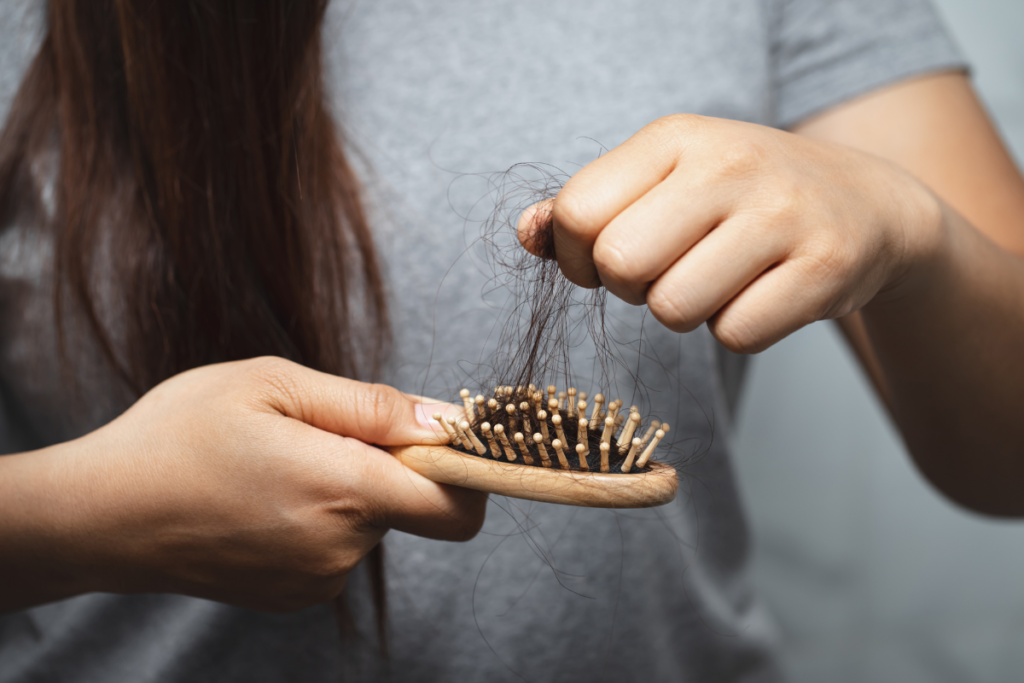
You wash your hair and notice more strands circling the drain. A few hours later, there are hairs on your clothes, pillow, and brush. It is easy to assume that every extra strand means you are developing permanent hair loss. But when comparing hair shedding vs hair loss, the pattern, timing, and underlying cause matter far more than the number of hairs you notice on one particular day.
Excessive hair shedding can happen temporarily after illness, childbirth, significant stress, rapid weight change, nutritional problems, or other disruptions to the normal hair cycle. Hair loss, on the other hand, can involve progressive thinning, follicle miniaturization, inflammation, autoimmune disease, or other conditions that need specific treatment. Knowing the difference can help you avoid panic, unnecessary supplements, and months of trial-and-error remedies.
Hair Shedding vs Hair Loss: What Is the Difference?
Hair shedding usually means more hairs than normal are entering the resting and shedding phase of the hair cycle, while hair loss refers to conditions in which hair growth is reduced, interrupted, or progressively altered. Shedding can be temporary, but true hair loss may continue without appropriate diagnosis and treatment.
The American Academy of Dermatology notes that losing around 50 to 100 hairs each day is normal. When substantially more hair begins falling out, dermatologists may describe it as excessive hair shedding.
The distinction is not always obvious at home. Some people experience shedding and hair loss at the same time, and temporary shedding can sometimes reveal underlying pattern hair loss that had previously been difficult to notice.
What Does Excessive Hair Shedding Look Like?
Excessive hair shedding commonly appears as an increase in loose hair from across the scalp rather than one clearly defined bald area. You may notice unusually large amounts while shampooing, brushing, running your fingers through your hair, or cleaning your pillow. The overall ponytail may also begin to feel thinner.
A common cause is telogen effluvium. Hair naturally moves through growth, transition, resting, and shedding phases. With telogen effluvium, a larger-than-usual number of follicles shift into the resting phase and later release their hairs.
According to DermNet, telogen effluvium can develop several months after an event that disrupts active hair growth. This delay is one reason people sometimes struggle to connect their current hair fall with something that happened months earlier.
Common Triggers for Telogen Effluvium
- High fever or significant illness
- Major surgery
- Childbirth
- Rapid or substantial weight loss
- Severe physical or emotional stress
- Changes in certain medications
- Nutritional deficiencies or inadequate nutrition
- Hormonal or metabolic changes
For example, someone may recover completely from an illness and then become alarmed when excessive shedding begins two or three months later. By that point, the original trigger can feel unrelated, but the delay fits the biology of the hair cycle.
When Is It More Likely to Be Hair Loss?
Hair loss becomes more likely when you notice a persistent reduction in density, progressive widening of the part, recession, distinct bald patches, changes in individual hair thickness, or areas that are not recovering over time. Different types of hair loss behave differently, so the visible pattern can provide important diagnostic clues.
Possible signs include:
- A progressively wider central part
- Increasing scalp visibility
- Gradual thinning over the crown
- Hair becoming finer over time
- A receding frontal or temporal hairline
- Smooth round or oval patches without hair
- Scalp redness, scaling, pain, or significant itching
- Loss of eyebrows, eyelashes, or other body hair
The American Academy of Dermatology describes several patterns and early signs that can help people recognize when hair loss deserves medical attention.
Hair Shedding vs Hair Loss at a Glance
| Feature | Excessive Hair Shedding | Hair Loss |
|---|---|---|
| Typical pattern | Often diffuse across the scalp | May be patterned, patchy, diffuse, or localized |
| Common timing | Can begin months after a trigger | May develop progressively or suddenly depending on cause |
| Hair calibre | Existing hairs may remain normal in thickness | Some conditions cause hairs to become progressively finer |
| Common example | Telogen effluvium | Female pattern hair loss, alopecia areata, scarring alopecia |
| Recovery | Often improves when the trigger resolves | Depends on the underlying diagnosis |
| Approach | Identify and correct the trigger where possible | Diagnosis-specific treatment and follow-up |
Female Hair Loss Can Be Easy to Miss Early
Female pattern hair loss often develops gradually, with reduced density over the top and central scalp rather than complete bald areas. The central part may become wider, the scalp may become easier to see, and individual hairs can become finer. Because the changes can be slow, early thinning is sometimes mistaken for ordinary shedding.
DermNet’s guidance on female pattern hair loss explains that increased shedding and reduced hair volume can both occur, and that chronic telogen effluvium may sometimes be confused with female pattern hair loss.
This distinction matters because simply waiting for the shedding to stop may not address progressive pattern thinning. Conversely, someone with temporary telogen effluvium may become unnecessarily frightened that every shed hair represents permanent follicle loss.
Can Telogen Effluvium and Pattern Hair Loss Happen Together?
Yes. Telogen effluvium can occur in someone who also has underlying genetic pattern hair loss. A period of heavy shedding may suddenly reduce density enough to make previously subtle thinning more noticeable. In these situations, the excessive shedding may improve while the underlying pattern hair loss still requires separate assessment and management.
This is one reason photographs taken several months apart can be more useful than repeatedly counting hairs in the shower. A dermatologist can look at changes in density, hair calibre, scalp pattern, and regrowth rather than relying on the number of strands lost on one day.
What Can Cause Hair Fall?
There is no single explanation for every episode of hair fall. Hair fall causes range from temporary changes in the hair cycle to inherited, autoimmune, inflammatory, nutritional, hormonal, and medication-related conditions.
The U.S. National Library of Medicine’s MedlinePlus lists factors including family history, certain illnesses, thyroid problems, medications, stress, and inadequate nutrition among possible contributors to hair loss.
A useful assessment therefore looks beyond the scalp. Your dermatologist may ask about:
- When the shedding started
- Recent illness, fever, surgery, or hospitalization
- Pregnancy and childbirth
- Menstrual and hormonal history where relevant
- Major weight or dietary changes
- New or recently stopped medications
- Family history of thinning hair
- Scalp symptoms such as itching, scaling, or pain
- Haircare practices and chemical treatments
How Dermatologists Assess Thinning Hair
Hair-loss diagnosis begins with identifying the pattern and possible cause rather than choosing a treatment first. A dermatologist may examine the scalp and hair density, compare hair thickness in different areas, review your medical history, perform a hair-pull test or trichoscopic examination, and request laboratory investigations when clinically appropriate.
The American Academy of Dermatology emphasizes that effective hair-loss treatment begins with determining the cause.
Blood tests are not automatically necessary for everyone. When your history or examination suggests an underlying issue, your doctor may investigate factors such as iron status, thyroid function, or other relevant medical concerns.
What Your Hair May Need Depends on the Diagnosis
| If the Main Problem Is… | The Plan May Focus On… |
|---|---|
| Telogen effluvium after a temporary trigger | Identifying the trigger, correcting contributing factors, and allowing the hair cycle time to recover |
| Female pattern hair loss | Evidence-based treatment aimed at preserving density and supporting hair growth |
| Nutritional deficiency | Confirming and correcting the deficiency rather than taking random supplements |
| Inflammatory or scalp disease | Controlling the underlying scalp condition |
| Patchy or unusual hair loss | Establishing the diagnosis before beginning treatment |
Hair treatment is rarely instant. Even when the underlying problem has been corrected, the hair cycle needs time to respond. This is why judging a treatment after only a few weeks can be misleading.
Common Mistakes When Hair Starts Falling More
- Counting every shed hair: Day-to-day variation can increase anxiety without identifying the cause.
- Starting several supplements at once: Supplements are not a substitute for identifying an actual deficiency.
- Assuming oil can treat every form of hair loss: Hair shaft conditioning and follicle disorders are different issues.
- Waiting too long despite progressive thinning: Some types of hair loss benefit from earlier diagnosis.
- Following the same treatment as a friend: Similar-looking thinning can have completely different causes.
- Stopping treatment too early: Hair growth takes time, and some evidence-based treatments require ongoing use.
DIY Hair Care vs Professional Assessment
Gentle haircare, balanced nutrition, and avoiding unnecessary heat or chemical damage can support hair health, but they cannot diagnose the cause of persistent thinning. Professional assessment becomes especially valuable when shedding continues, density is progressively decreasing, bald patches appear, or the scalp is painful, inflamed, itchy, or visibly scarred.
The NHS guidance on hair loss also distinguishes between temporary and longer-term forms of hair loss and advises seeking medical assessment when you are concerned about your symptoms.
Rather than buying another product because it promises “hair fall control,” ask a more useful question: are your follicles shedding temporarily, producing progressively finer hairs, or being affected by another scalp or medical condition?
Frequently Asked Questions
How can I tell the difference between hair shedding and hair loss?
Excessive shedding usually causes noticeably more loose hair from across the scalp, often after a physical or emotional trigger. Hair loss may produce progressive thinning, a wider part, localized bald patches, or increasingly fine hairs. Because both can occur together, persistent changes in density are best assessed by a dermatologist.
How much hair shedding is normal?
Losing roughly 50 to 100 scalp hairs per day is commonly considered normal, although you may notice more on wash days depending on hair length and washing frequency. A sudden, sustained increase beyond your usual pattern is more informative than trying to achieve an exact daily hair count.
How long after stress can telogen effluvium begin?
Telogen effluvium commonly becomes noticeable several months after an illness, major stressor, surgery, childbirth, rapid weight change, or another trigger. The delay occurs because affected follicles first move through the resting phase before the hair is released, so the original event may seem distant when shedding starts.
Does thinning hair in women always mean female pattern hair loss?
No. Thinning hair in women can result from telogen effluvium, female pattern hair loss, nutritional or medical problems, alopecia areata, inflammatory scalp disease, medications, and other causes. The distribution of thinning, hair calibre, timing, medical history, and scalp examination help determine which diagnosis is more likely.
Will hair grow back after excessive shedding?
Hair commonly regrows after acute telogen effluvium when the trigger has resolved and there is no separate condition affecting follicle growth. Recovery is gradual because follicles must re-enter the growth phase. Persistent shedding, continued density loss, or incomplete recovery should prompt reassessment for an ongoing trigger or another hair-loss condition.
When should I see a dermatologist about hair fall?
Seek assessment when shedding persists, your part is widening, scalp visibility is increasing, bald patches appear, or you develop redness, scaling, pain, or significant itching. Sudden or rapidly progressive hair loss also deserves evaluation. Early diagnosis is particularly useful when a condition could continue affecting follicle function without treatment.
For more patient experiences and treatment journeys, you can also read more inspiring stories.
Conclusion: Understand the Pattern Before Treating It
Understanding hair shedding vs hair loss can change the way you respond when more hair begins appearing in your brush or shower. Temporary excessive shedding, including telogen effluvium, can look dramatic but may recover once the trigger has passed. Progressive thinning, pattern changes, or patchy hair loss can point to a different process that needs targeted care.
Your hair does not need every serum, supplement, or treatment at once. It needs the right diagnosis first. Once we understand why the shedding or thinning is happening, treatment can be selected around the actual condition rather than the fear created by the hairs you see falling today.
Concerned About Hair Shedding or Thinning?
Book a hair and scalp consultation: If your shedding has increased or your hair density is changing, a dermatologist-led assessment can help identify the pattern, possible triggers, and appropriate next steps.
Speak with our team: If you have questions about excessive shedding, female hair loss, thinning hair, or available professional treatments, contact us to discuss which assessment may be suitable for your concern.